Relationship and scope. Edelmasche is an owned store in the same business portfolio as FeedSteady. It uses a custom storefront, German and Swedish pages, and EUR pricing. This is an internal technical diagnostic, not an independent paying-client testimonial or a Shopify implementation case.
The finding
The Sternennacht sweater displayed a price of €99 and five sizes: S, M, L, XL and 2XL. Opening its German product URL with ?size=M left every size unselected and the purchase button asking the shopper to choose a size. The equivalent Swedish URL behaved the same way.
As a control, clicking M on the Swedish page selected medium and changed the button to “Lägg i varukorgen” (add to basket). The size selector itself worked; opening the size-specific URL did not produce that selected state. No order was placed.
Confirmed outcome: a documented landing-page selection gap. We have not deployed a repair or measured a change in sales, traffic, Google approval or disapproval. We did not inspect an active Merchant Center data source, so we cannot say whether these URLs are currently submitted to Google.
The evidence, side by side
| Check | Expected for a medium link | Observed |
|---|---|---|
German URL, ?size=M | M selected on arrival | No selected size; “Größe wählen” |
Swedish URL, ?size=M | M selected on arrival | No selected size; “Välj storlek” |
| Manually click M on Swedish page | M selected; purchase button ready | M selected; “Lägg i varukorgen” |
| Visible price / published Offer price | Consistent price and currency | €99 / 99 EUR on the sampled product |
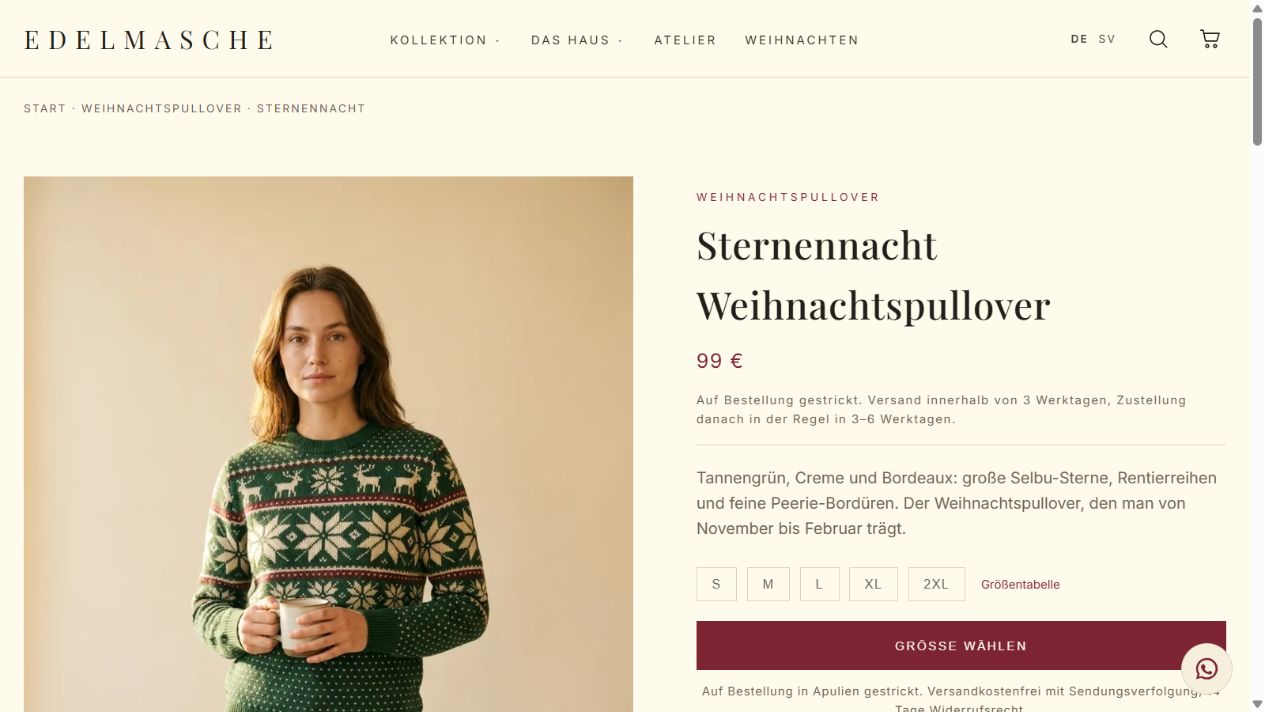
?size=M test. Open the image for detail; the exact test URLs are below.- German product and medium-size test URL
- Swedish product and medium-size test URL
- Download the dated public-page evidence (JSON)
- Download the browser observations (JSON)
Live pages may change after this observation. Downloads record the time, URLs, observed fields and page hashes. The screenshot and observations describe the state at audit time.
Why this matters for a product feed
A size attribute in a feed does not make the store select that size. The landing-page link needs to open the intended option. Google’s link attribute guidance recommends correct variant preselection and gives examples of URLs that select a variant.
This case establishes a readiness issue for this URL format. It does not establish a current feed mismatch. The next diagnostic step would be to obtain the actual submitted item and its final link, then compare that exact URL, size, price and target market. We would not infer an account error from the storefront alone.
How we bounded the finding
We fetched the product URLs listed in both public sitemaps. All 50 returned successfully: the same 25 styles in two languages. Twenty-two styles offered five sizes and three offered one size, giving 113 product/size combinations—not 226 distinct products and not a verified Merchant Center row count.
Forty-four localized pages shared the multi-size pattern. We checked the live theme asset and compared it with the available source: the newer source contained size-query handling that the served asset lacked. That supports a source-to-production gap, but the interactive failure was verified only on the two Sternennacht URLs. A complete repair must test the other sizes and products too.
The bare product URL deliberately asks shoppers to choose a size. That behavior is not itself the finding. The issue is that a URL intended to select M did not do so. We also found no price discrepancy in the sampled €99 product, and did not label made-to-order production as an availability error.
The proposed repair handoff
- Confirm the link contract. Obtain the real submitted links and decide which query parameter and exact size values the store supports.
- Reconcile source and production. Review the deployment difference before publishing. A broad rebuild would pull in unrelated theme changes; preserve both language versions and existing checkout behavior.
- Apply a bounded selection change. Accept only a size present on that product. Use the existing selection behavior so the visible size and purchase-button state agree. Leave invalid values and bare URLs in a safe, unselected state.
- Verify before updating feed links. Test all five sizes, invalid values, one-size products, both languages, mobile and desktop. Check the basket item matches the selected size without placing a test order.
- Close the loop in Merchant Center if applicable. Compare the actual processed link and attributes with the repaired page. Record Google’s observed status separately from the technical fix.
Suggested owner: storefront developer for URL selection and deployment; feed operator for submitted-link mapping; store owner for product truth. Priority: resolve the landing behavior before relying on size-specific shopping links. No revenue-impact estimate is assigned.
Get this level of evidence for your store.
$299, one diagnostic. For a US-facing Shopify apparel or accessories store: up to 2,500 variant rows and 20 manual product URL checks, one store and one target country. You receive an issue register, evidence, likely cause, repair owner and verification plan.
Send your store URL, the issue you see, target country and approximate variant count. We confirm fit, access and delivery timing before a private payment link. No account password is needed in the inquiry.
Request a $299 diagnosticRepairs are separate. The $299 is credited toward a $750 total repair pilot if agreed, leaving $451. Applicable tax is confirmed before purchase. No Google approval or revenue guarantee.
Compare the synthetic report format, read our price and variant mismatch guide, or see the agency handoff.